Metal corrosion is one of the most common and costly problems across industries such as automotive, aerospace, construction, and heavy manufacturing. Rust not only weakens metal but also increases maintenance costs, reduces operational efficiency, and shortens the lifespan of valuable equipment. Traditional rust removal methods—mechanical scraping, sandblasting, or chemical treatments—often damage the metal surface, produce hazardous waste, and require substantial labor.
In contrast, the laser rust cleaner provides a precise, non-destructive, and environmentally friendly solution. By targeting only the rust layer and leaving the underlying metal intact, laser cleaning is revolutionizing how industries maintain and restore metal components. This article provides a comprehensive guide to laser rust cleaner for metal, including their working principle, types, benefits, applications, and real-world examples.
What is a Laser Rust Cleaner for Metal?
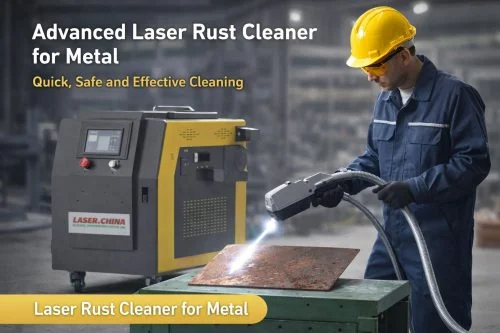
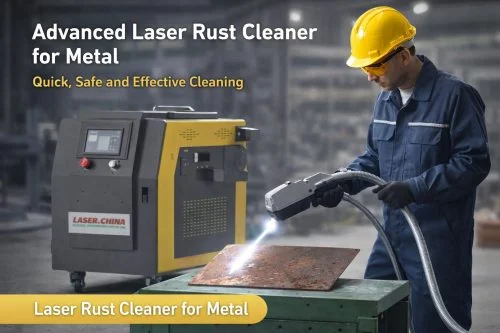
A laser rust cleaner for metal is a high-tech device designed to remove corrosion, oxide layers, and surface contaminants without physical contact or chemicals. It works by directing a high-intensity laser beam at the rust, causing it to vaporize or flake off while preserving the base metal. Unlike traditional cleaning methods, which often remove both rust and some metal, laser cleaning is highly controlled and precise.
Key details from industrial case studies:
- Rust removal efficiency can reach 95–100% on steel and iron surfaces.
- Chemical usage is entirely eliminated, reducing environmental impact and disposal costs.
- Cleaning speed is significantly higher, reducing downtime in maintenance operations.
Laser rust cleaners are available in different formats, including handheld units for small or delicate work, mobile systems for industrial applications, and compact luggage-style units for field operations. Their adoption is growing across industries that value precision, safety, and efficiency.
How Laser Rust Cleaning Works
The Science Behind Laser Rust Removal
Laser rust cleaning operates based on photothermal and photomechanical effects. The laser beam emits concentrated energy, which is absorbed by the rust layer. This rapid absorption causes the rust to heat, expand, and either vaporize or crack away from the metal surface. The underlying metal absorbs less energy and remains intact, ensuring non-destructive cleaning.
Technical insights:
- Common wavelengths include 532 nm (green) and 1064 nm (infrared), selected based on rust type and thickness.
- Adjustable pulse width, repetition rate, and scanning speed allow optimization for delicate or thick layers.
- Cooling mechanisms (air or water) prevent thermal stress and warping on sensitive metals.
This scientific approach ensures uniform rust removal and surface preparation for further treatment, such as painting or coating, without damage.
Comparison with Traditional Methods
Laser cleaning outperforms conventional rust removal in efficiency, precision, and environmental safety. Sandblasting can erode metal, chemical treatments produce toxic waste, and mechanical scraping is labor-intensive and uneven.
| Method | Surface Damage | Efficiency | Environmental Impact | Consumables |
|---|---|---|---|---|
| Laser Cleaning | None | High | Low | None |
| Sandblasting | Medium | Medium | High | Sand/Grit |
| Chemical Treatment | High | Medium | Very High | Acids/Solvents |
| Mechanical Scraping | High | Low | Medium | Tools |
Industrial studies have shown that laser cleaning reduces labor costs by 30–50%, shortens downtime, and eliminates hazardous chemical handling. It also prepares the surface optimally for subsequent coatings or repairs, improving overall operational efficiency.
Types of Laser Rust Cleaners
Portable Handheld Laser Rust Cleaners
Handheld laser cleaners are compact, lightweight, and ideal for small or detailed tasks. They are widely used in automotive repair, workshop maintenance, and pipeline cleaning where precision is required.
Key features:
- Weight: 15–30 kg, making them easy to maneuver in confined spaces.
- Adjustable laser power to handle varying rust thickness.
- Single-operator design for portability and flexibility.
- Can clean complex geometries without disassembly.
Industrial examples show handheld lasers are particularly effective in classic car restoration, where traditional abrasives risk damaging body panels or engine components.
Mobile and Industrial Laser Rust Cleaners
Mobile or industrial laser systems are designed for high-volume, large-scale cleaning tasks. They offer high laser power (up to 6000W) and continuous operation through advanced water-cooling systems.
Applications include:
- Steel factories, shipbuilding yards, and offshore platforms.
- Bridges, railways, and other large metal structures.
- Heavy machinery maintenance and restoration.
These systems can remove thick rust layers efficiently, reduce operational downtime, and allow operators to cover large surface areas with minimal effort. Industrial adoption has shown significant cost savings and higher surface quality than sandblasting or chemical treatments.
Mini Luggage Laser Rust Removers
Mini luggage-style laser cleaners combine portability with industrial-level efficiency. They are ideal for mobile service teams or smaller workshops requiring flexible solutions.
Advantages:
- Quick setup and deployment at different sites.
- Adjustable parameters for precision cleaning on delicate metals.
- Eliminates the need for chemical agents.
- Efficient for medium-scale maintenance tasks.
They are particularly effective for infrastructure projects where mobility is essential, such as rail maintenance or field pipeline cleaning.
Benefits of Using a Laser Rust Cleaner
Non-Destructive and Precise
Laser rust cleaners remove rust without affecting the metal beneath. Multiple cleaning cycles do not reduce metal thickness, unlike mechanical or chemical methods, which often cause erosion or pitting.
This precision is essential in industries like aerospace, automotive restoration, and electronics, where component integrity is critical. It also improves the adhesion of coatings or paint applied after cleaning.
Eco-Friendly and Chemical-Free
Laser cleaning eliminates harmful acids, solvents, or abrasive media. This reduces environmental contamination and workplace hazards while eliminating disposal costs. Industrial studies show that laser cleaning can completely replace chemical treatments in maintenance operations.
This aligns with global sustainability standards and reduces the risk of fines or environmental violations.
Time and Cost Efficiency
Laser cleaning is significantly faster than conventional methods. Typical cleaning speeds range from 1–2 m² per hour, depending on rust thickness and laser power. Industrial case studies report labor cost reductions of 30–50% due to fewer personnel and reduced cleaning times.
Shorter downtime also improves productivity, particularly in high-volume manufacturing or maintenance operations.
Safety Advantages
Operators face fewer hazards with laser cleaning. The process is dust-free, non-contact, and eliminates chemical exposure. Safety features, such as beam shut-offs and protective shields, further reduce risk.
This improves overall workplace safety while maintaining operational efficiency, a significant advantage over abrasive blasting or chemical cleaning.
Applications of Laser Rust Cleaners
Automotive Industry
Laser rust cleaners are widely used in vehicle restoration and repair. They allow rust removal from chassis, engines, and body panels without disassembly or risk of damage.
Example: Classic car restoration workshops reduced cleaning time from 5 hours to 1 hour per part, while preserving paint and metal integrity. Laser cleaning also improves surface preparation for repainting or protective coatings.
Industrial Equipment
Heavy machinery and steel frameworks are highly susceptible to corrosion. Laser cleaning extends equipment lifespan by efficiently removing rust and preventing further oxidation.
A steel plant that adopted mobile laser cleaning reported a 40% increase in equipment lifespan and significant labor savings. The process also reduces the need for frequent replacement or extensive repair work.
Infrastructure Maintenance
Bridges, pipelines, and railways require periodic rust removal. Portable laser cleaners enable field technicians to operate safely outdoors, removing corrosion efficiently without chemicals.
Precision cleaning reduces maintenance cycles, preserves structural integrity, and allows for long-term monitoring of metal conditions.
Aerospace and Electronics
Laser cleaning removes rust and oxidation from delicate components without affecting tolerances, conductivity, or surface quality.
This precision is critical for aerospace, electronics, and high-tech manufacturing, where traditional methods can damage parts and compromise safety or functionality.
Choosing the Right Laser Rust Cleaner
Power and Wavelength
Choosing the right power and wavelength is essential. Low-power units (50–200W) work for delicate metals, while high-power systems (1000–6000W) are required for thick industrial rust.
Wavelength selection: Green lasers for thin coatings, infrared for heavy corrosion. Proper selection maximizes efficiency and prevents damage to underlying metal.
Portability and Design
Handheld units are ideal for detailed or confined work, while mobile industrial units are suitable for large-scale cleaning. Portability affects workflow efficiency, speed of operation, and adaptability to different job sites.
Cooling System and Duty Cycle
Air-cooled lasers suffice for intermittent cleaning, but continuous industrial operations require water-cooling to maintain laser stability and prevent overheating. Cooling directly affects performance, efficiency, and lifespan of the laser system.
Brand Reliability and Support
Choosing a trusted brand ensures reliable performance and access to technical support. LaserCleaner provides proven solutions with customizable configurations, making it suitable for diverse industrial needs. Brand support ensures long-term functionality and reduces operational risks.
Real-World Case Studies
Automotive Restoration
A workshop replaced chemical rust removal with handheld lasers. Results: 100% rust removal, reduced cleaning time from 5 hours to 1 hour per part, preserved metal integrity, and eliminated chemical hazards.
Industrial Steel Maintenance
A steel plant used a mobile laser cleaner on pipelines and structures. Results: 95% rust removal, 45% labor cost reduction, 30% downtime reduction, and zero chemical waste.
Infrastructure Projects
Bridge maintenance crews used portable laser cleaners to remove rust in confined areas. Long-term structural integrity was maintained, and worker safety improved due to no chemical exposure. The precision of laser cleaning reduced repeated maintenance needs.
Maintenance and Operational Tips
Operator Training
Training ensures safety and efficiency. Operators must follow laser parameters, pulse settings, distance, and protective equipment instructions to avoid damage or accidents. Proper training also optimizes cleaning speed and quality.
Regular Equipment Inspection
Routine checks of optical systems, cooling units, and laser output prevent downtime and extend lifespan. Maintenance schedules should include cleaning lenses, checking alignment, and monitoring power output.
Surface Assessment and Preparation
Evaluate rust thickness, metal type, and surface condition before cleaning. This allows correct laser parameters selection for efficiency, prevents under- or over-processing, and ensures optimal results.
Future of Laser Rust Cleaning
The adoption of laser rust cleaners for metal is rapidly increasing as industries prioritize sustainability, efficiency, and precision. Fiber laser technology, AI-assisted cleaning, and robotic integration are expected to make operations faster, more accurate, and energy-efficient.
Industries like automotive, aerospace, and infrastructure will increasingly rely on laser cleaning for maintenance, restoration, and preservation. Laser rust cleaners reduce labor costs, eliminate chemical waste, and preserve metal integrity, setting the standard for modern industrial cleaning practices.
Final Thoughts
The rise of laser rust cleaners for metal marks a significant shift in industrial maintenance and restoration practices. Unlike traditional methods, laser cleaning offers unmatched precision, safety, and environmental sustainability. It effectively removes rust, oxidation, and surface contaminants without damaging the underlying metal, eliminating the need for chemicals, abrasives, or labor-intensive procedures.
Industries from automotive restoration to large-scale infrastructure maintenance are increasingly adopting laser rust cleaners due to their speed, cost efficiency, and ability to preserve structural integrity. Case studies across steel plants, bridge maintenance projects, and classic car restorations highlight measurable benefits, including reduced downtime, labor savings, and extended equipment lifespan.
As technology advances with fiber lasers, AI-assisted cleaning, and robotics integration, the scope and efficiency of laser rust cleaning will continue to grow. For businesses and maintenance teams looking for a reliable, safe, and environmentally responsible solution, investing in a laser rust cleaner is not just a choice—it’s a strategic decision for long-term efficiency, sustainability, and quality.