
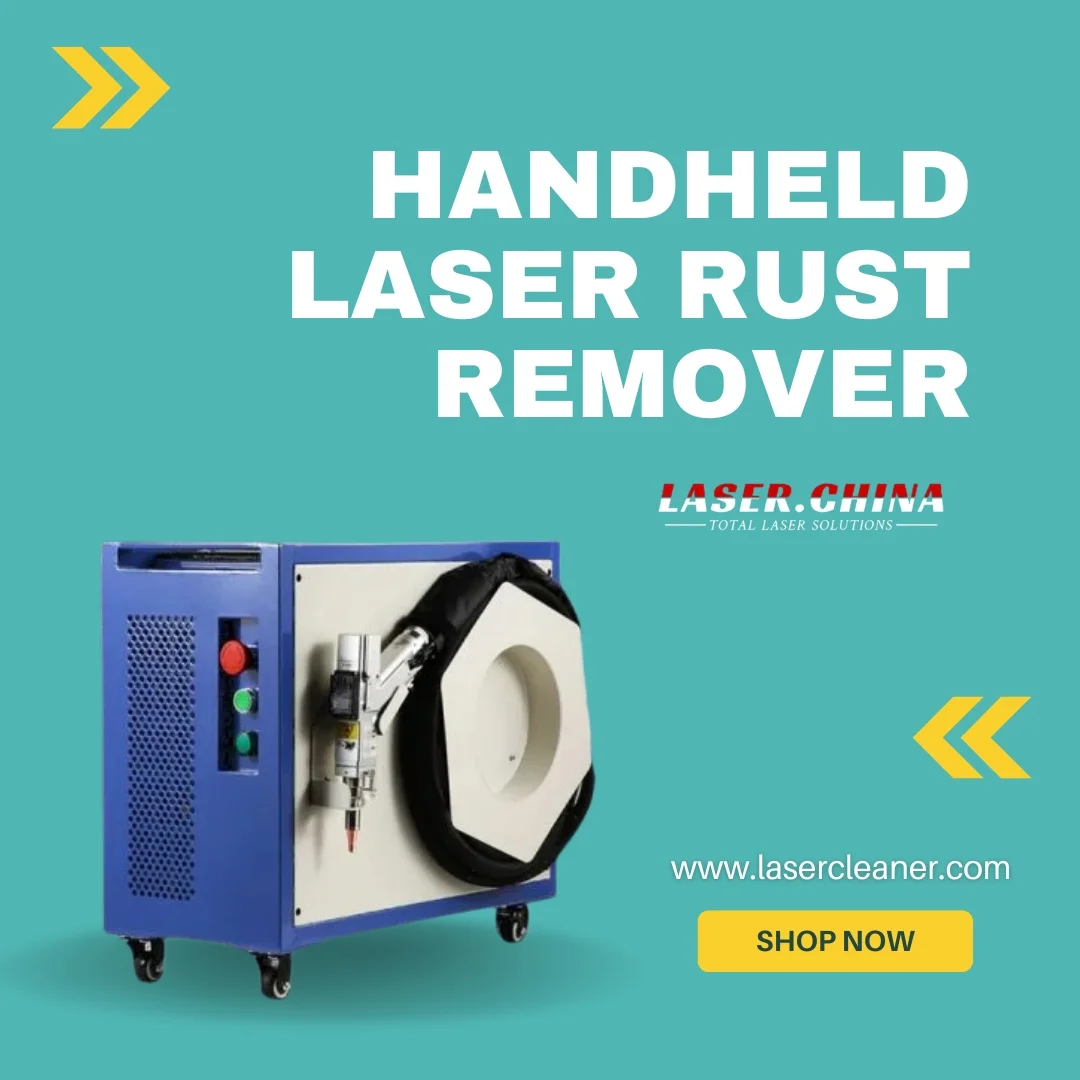
Rust is one of the most persistent challenges in metalworking, automotive repair, and industrial maintenance. It not only affects the appearance of metal surfaces but also compromises structural integrity over time. Traditional rust removal methods, such as chemical treatments, sandblasting, and mechanical abrasion, are often labor-intensive, time-consuming, and can introduce safety or environmental hazards.
Professionals are increasingly turning to handheld laser rust remover as a more precise and efficient alternative. These devices use focused laser beams to remove rust by vaporizing the oxidized layer without affecting the underlying metal. However, the effectiveness of a handheld laser rust remover depends heavily on selecting the right power, pulse frequency, and scanning speed.
Using insufficient power may leave rust behind, while excessive power can damage the metal surface or create safety risks. Understanding how to calibrate and operate these devices is crucial for professional applications where efficiency and surface quality are critical.
In this guide, we will explain the power requirements, operating techniques, and practical considerations for using a handheld laser rust remover for professional rust cleaning.
Table of Contents
Handheld laser rust remover power guide for professional rust cleaning
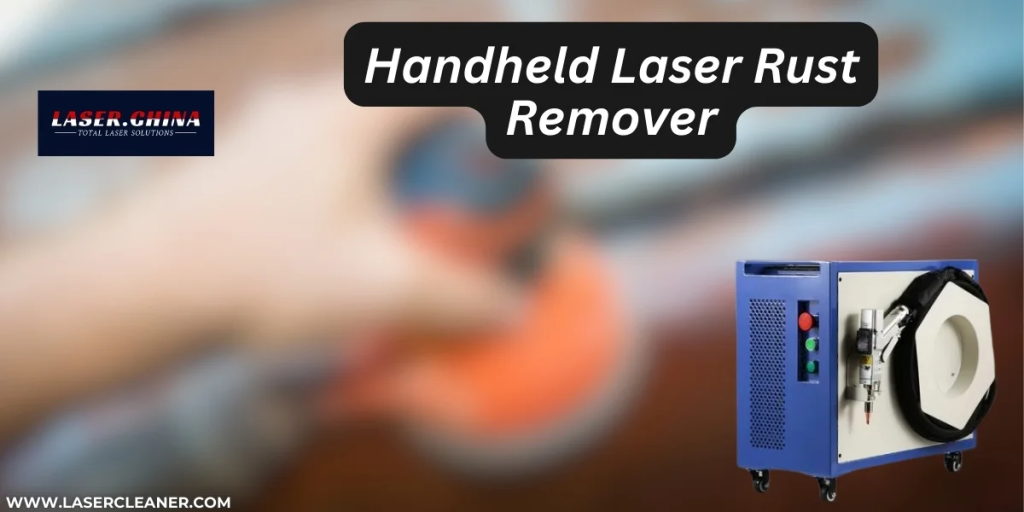
Handheld laser rust removers are portable, high-powered cleaning tools that use focused laser beams to remove rust and surface contaminants from metal without chemicals or abrasion. By directing intense laser energy onto a rusted surface, the laser vaporizes the iron oxide (rust) and any coatings, leaving a clean metal substrate behind.
Because this is a non-contact process that uses only light energy, it preserves the underlying metal’s integrity while avoiding the dust and pollution of grinding or sandblasting. In professional rust cleaning, understanding and optimizing the laser’s power settings (measured in watts) is crucial: the available wattage and related power specifications directly determine how quickly and effectively the machine can strip rust.
What is a Handheld Laser Rust Remover?
A handheld laser rust remover is essentially a portable laser cleaning device designed specifically for derusting and contaminant removal on metal surfaces. It typically consists of a laser source (often a fiber laser) and a handheld gun or nozzle. When activated, the machine emits a concentrated laser beam that scans over the rusted area.
The beam’s high-energy pulses heat and vaporize the rust layer without touching the metal, effectively “blasting” the oxidation away at a microscopic level. The laser energy interacts primarily with the rust and coatings, causing them to absorb the light and dissipate as gas or tiny particles, while the base metal reflects most of the energy and remains undamaged.
Because the process is non-contact and does not involve chemicals or abrasive media, it produces very little secondary waste (no sand, grit, or caustic residue) and imposes minimal mechanical stress on the workpiece.
Handheld laser cleaners are widely used in industrial maintenance, manufacturing, and restoration. They can remove rust from hard-to-reach areas, complex shapes, and delicate components where traditional methods are impractical. For example, an operator simply sweeps the laser nozzle over a corroded steel surface, and the rust “disappears” under the beam’s pulses.
Since no abrasive contact is involved, there are no scratches or tool marks left on the metal, and the original surface roughness and properties (hardness, hydrophilicity) remain largely intact. This precision makes handheld laser rust removers ideal for applications such as cleaning molds, maintenance of machinery, restoration of historic artifacts, or aerospace and military part refurbishment, where preserving tight tolerances is important.
The device’s portability means a single machine can serve across a workshop or field site, as it often has wheels or a carry handle.
The Importance of Power in Handheld Laser Rust Removers
The performance of a handheld laser rust remover is fundamentally determined by its power output. “Power” in this context refers to the laser’s wattage – the amount of energy it can emit per second. Higher wattage means the laser delivers more energy to the rust layer, which in turn affects both cleaning speed and capability.
In simple terms, a more powerful laser can remove rust faster and handle thicker, more stubborn corrosion. Conversely, a lower-power laser will work more slowly and may only be practical for thin coatings or light surface rust.
Specifically, power influences several key factors:
- Cleaning Speed: Higher wattage lasers can clear a given area more quickly. Because they deposit more energy, they vaporize contaminants in larger amounts per pass. For example, a 500W laser head will clean a sheet of mild steel much faster than a 100W head. In high-volume production or field maintenance, speed is critical; a powerful unit significantly cuts the time required to prep large components. Manufacturers often choose higher-powered laser models when throughput is a priority.
- Effectiveness on Tough Rust: Stronger lasers penetrate deeper through layers of oxidation. Stubborn or thick corrosion may need the intense pulses that only a high-power device can provide. Lower-powered lasers might fail to remove all rust in one pass, requiring multiple passes or being unable to clean very heavy rust at all. In contrast, a high-wattage laser can break up and vaporize multiple rust layers in one go, delivering a thorough cleaning with fewer scans.
- Material Compatibility: The material being cleaned also dictates power needs. Delicate or thin metals (like aluminum body panels or painted components) can overheat or warp if blasted with excessive power. Therefore, operators must use an appropriately lower power setting for sensitive substrates, even if that means slower cleaning. Conversely, for robust metals (steel, iron) and thick coatings, higher power is preferable. Understanding which power level suits each material ensures optimal results without damage.
- Energy Use and Cost: Power level also affects operational costs. Higher-wattage lasers consume more electricity during use, which could raise energy bills. However, because they clean faster, they often reduce labor time and may offset higher power consumption. In practice, a balance is sought: using enough power to clean efficiently while not wasting energy unnecessarily. Modern handheld units may offer adjustable power controls to dial in the minimum effective wattage, helping to balance efficiency and cost.
Key Power Specifications to Know
When evaluating or using a handheld laser rust remover, there are several power-related specifications to consider. Understanding these will help in selecting the right equipment and settings.
Wattage (Laser Power): This is the fundamental specification. Handheld laser rust removers are offered in a range of power levels, typically from around 100 watts up to 1000 watts or more. The wattage determines the maximum energy output. As a general guideline:
- 100–200W Models: These low-power units are intended for light cleaning tasks and thin metals. They can remove surface rust, light oxidation, paint, or oil stains on smaller parts. For instance, 100W–200W lasers are suitable for delicate components or detailed work where only mild derusting is needed.
- 300–500W Models: Mid-range lasers strike a balance between power and portability. These are the most common industrial units for general rust removal. A 300W–500W handheld can efficiently clean medium-thickness rust on steel parts, strip old paint on machinery, or prepare surfaces for welding. They handle a wider variety of applications without requiring extreme power.
- 700–1000W and Above: High-power handheld lasers are used in heavy-duty scenarios. A 1000W (1kW) machine, for example, can clear very thick rust or multiple coating layers much faster. Such powerful lasers are suited to large-scale industrial jobs like cleaning ship hull sections or thick corroded structures. If speed and broad coverage are needed, a 700W+ unit is the preferred choice.
Laser Beam Pulse Rate: Many handheld lasers operate in pulsed mode, emitting bursts of energy at a certain frequency (often measured in kilohertz, kHz). A higher pulse rate means the laser fires energy more often per second. High pulse rates generally increase cleaning speed because they deliver energy continuously to the surface.
Lower pulse rates put more energy in each pulse and may be better for precise, delicate removal (since there is time between pulses to cool the spot). When choosing a unit, note the adjustable pulse parameters: being able to control frequency and pulse width allows tuning between aggressive cleaning and careful precision.
Power Supply Type (AC vs DC): Handheld machines may be powered by alternating current (AC) from the mains or a direct current (DC) laser source. AC-powered lasers are common and convenient for workshop environments. DC lasers (often battery-based or using DC power modules) can offer more stable and consistent output under varying load conditions.
For very demanding cleaning, a stable power supply ensures the laser maintains constant intensity, which can be important for uniform results. Some professional units may even allow battery use for remote locations, which should be matched carefully to power needs.
Energy Efficiency Features: Advanced handheld rust removers include built-in systems to maximize energy use. Active cooling (like water or air coolers) lets the laser run at higher power without overheating, effectively allowing continuous operation at high wattage.
Additionally, power management circuits can adjust energy delivery during operation. These features reduce overall power consumption by ensuring that excess energy isn’t wasted as heat. When evaluating machines, check if they list energy-saving modes or cooling efficiency; these will impact long-term cost and uptime.
By understanding these specifications – wattage, pulse rate, power supply, and efficiency systems – professionals can choose a handheld laser rust remover suited to their needs.
For example, a maintenance team needing a portable unit for varied tasks might opt for a 500W AC-powered machine with adjustable pulse settings, whereas a field crew cleaning heavy equipment might invest in a 1000W DC unit with robust cooling. Knowing each parameter ensures the laser’s power matches the application safely and effectively.
Understanding the Impact of Power on Performance
The chosen power level of a handheld laser rust remover has several practical effects on its performance during cleaning. It’s not just about “more watts equals better”; it’s about how power influences speed, depth of cleaning, heat, and control.
Speed and Coverage: In general, higher power means faster cleaning. A strong laser can ablate a larger area per unit time. For instance, a 1000W laser can vaporize thick rust and clear broad sections quickly, whereas a 200W laser must move slower or make multiple passes.
Faster cleaning reduces labor time and allows operators to cover large surfaces efficiently. In an industrial setting, this translates to shorter downtime or higher throughput. Essentially, power output sets the upper limit on the cleaning rate – a limitation only remedied by switching to a more powerful model.
Depth of Cleaning: Power also determines how deeply the laser can penetrate rust layers. Rust often builds up in layers; a strong beam can penetrate multiple layers at once. If the rust is very thick, a low-power laser might only chip away the surface layer without fully reaching the underlying metal.
A higher power machine delivers more concentrated energy into the contaminant, effectively breaking down even tough corrosion in one cycle. On the other hand, if the rust is light or shallow, even a low-power laser can remove it eventually – it will just take longer.
Heat Generation: A downside of high power is increased heat. When the laser beam strikes a surface, not all energy converts to rust removal – some heats up the material. Intense beams can heat metal significantly. In sensitive applications (thin sheet metal, plated parts, or heat-treated components), excessive heat might warp or discolor the substrate. Therefore, power must be managed to prevent damage.
Most handheld units include adjustments to lower the output when needed. By reducing wattage or running in short pulses, operators can keep surface temperature down. This feature is vital when working on delicate parts where minimal thermal impact is required.
Precision and Control: High power tends to burn broadly, while lower power allows finer control. For very precise cleaning (such as removing rust from a small weld seam or electronic component), a technician might use the lowest effective power setting to ensure only the unwanted material is ablated.
Many modern systems offer fine-tuned control – users can dial the power up or down and adjust pulse width or frequency. This flexibility ensures that even with a high-rated machine, one can operate at low power for precision tasks. Precision control means the laser can be effective across multiple use-cases: for example, cleaning a fine mold cavity at low power, then cranking up the wattage for rough steel before switching tasks.
Optimal Power Requirements for Different Applications
Different cleaning tasks call for different laser powers. Here are typical guidelines for professional rust cleaning and related applications:
- Rust Removal: This is the primary use case. For light rust on industrial equipment (thin oxidation or small parts), a moderate-power laser (around 300–500W) is usually sufficient. It will strip away minor corrosion quickly. If rust is severe – for example, thick scale on a ship hull or old heavy machinery – higher power is needed. Units rated 700W or above can break through deep rust layers more effectively. In extreme cases, very high power (1000W+) can handle large surfaces rapidly. Professionals often match power to rust thickness: a regular maintenance schedule might use a 500W cleaner for daily or weekly rust, while rare heavy jobs might warrant a 1kW system.
- Paint and Coating Stripping: Industrial paints and coatings can be tough, but they often respond well to laser. Common practice is to use around 500–700W for normal paint layers. This level can remove most coatings without excessive passes. In automotive or shipyard work where multiple coats of thick paint exist, a 1000W handheld laser may be used to finish quickly. The same principle applies: thicker or more tenacious coatings demand higher power.
- Sensitive or Thin Materials: For delicate surfaces – such as electronics, thin sheet metal, or precision components – it’s safer to use low-power settings. Machines as low as 100–300W (or the lower end of a powerful unit’s range) are preferred. This lower output still ablates rust but minimizes heat conduction into the metal, protecting it from warping. For example, cleaning rust off a thin steel panel or aluminum casting can be done effectively with a few hundred watts, provided multiple light passes. The goal is to remove contaminants without compromising the substrate.
- Surface Preparation for Coating or Welding: Before painting or welding, surfaces are often cleaned of oil, rust, and scale. These tasks require a clean, fresh metal surface. Generally, this requires only modest power. A setting around 100–300W can remove residual oil films or light oxide layers without altering the base material. However, if the part has more substantial contaminants, power may be increased temporarily. Surface preparation is about achieving cleanliness without changing geometry, so professionals typically err on the side of lower power unless absolutely needed.
Final Thoughts
A handheld laser rust remover is more than just a cleaning tool—it is a precise, controllable, and efficient method for removing rust and surface contaminants in professional environments. The key to achieving the best results lies in understanding power requirements.
Low power settings are sufficient for light rust or delicate components, while mid- to high-power machines are better suited for thick, stubborn rust and large surface areas. Adjusting wattage, pulse frequency, and scanning speed allows operators to match the tool to the job, ensuring efficiency without risking damage to the underlying material.
By focusing on the right power levels, professionals can save time, reduce energy waste, and maintain the integrity of the metal surface. Whether used for routine maintenance or demanding industrial derusting, a handheld laser rust remover delivers consistent, predictable results when properly calibrated. With correct operation and an informed approach to power settings, this technology becomes a reliable solution for professional rust cleaning.